Tinianow Testimony
Undercuts Key Assumption of Ohio Senate Group Opposing Compact
In testimony before the Ohio Senate Environment and Natural
Resources Committee on April 30, Audubon Ohio Executive Director
Jerry Tinianow argued that supporters of Senate Bill 291,
an effort to rewrite the Great Lakes Basin Water Resources
Compact, were basing their sole remaining argument against
the Compact on a fundamentally faulty premise.
Senator Tim Grendell and his allies who have sponsored the
bill have argued that the Compact will undermine private property
rights in Ohio unless amended. Tinianow demonstrated that
the amendment proposed in the bill, as well as a separate
amendment of the Ohio Constitution that Grendell would like
to place before the voters, would do virtually nothing to
enhance property rights, but would create a serious impediment
to ratification of the Compact.
"Neither a constitutional nor a Compact amendment offers
any significant relief from the unlikely prospect of judicial
activism that troubles the proponents of Senate Bill 291.
Rather, pursuing either puts the Compact process at significant
risk," said Tinianow.
Tinianow pointed out that a Compact amendment would require
the Ohio House and the legislatures from seven other states,
not only to concur in the amendment, but to refrain from circulating
their own amendments, a prospect he described as extremely
unlikely. He also said that a constitutional amendment was
"fraught with uncertainties," including what the
amendment would say, whether it would be approved by the voters,
and even whether Sen. Grendell could get it on the ballot.
During questioning after Tinianow completed his prepared
testimony, Sen. Grendell may have tipped his hand as to his
real motivation for trying to undermine the Compact. Grendell
began questioning Tinianow about an unrelated lawsuit in Lake
County, to which Audubon is not a party, involving the rights
of lakefront property owners to bar the public from the Lake
Erie beach below the ordinary high water mark. Before he could
complete the question, Grendell was cut off by Committee Chairman
Tom Niehaus, who directed Grendell to move on to another question.
Some have speculated that Grendell's efforts to undermine
the Compact are a form of payback for the successful efforts
of Audubon Ohio and other groups to block legislation that
would have privatized most of the Lake Erie shore.No further
hearings on Grendell's bill have been scheduled. Conservationists
are now waiting to see whether the Committee will act on the
bill before the General Assembly recesses for the summer in
early June.
Grange Insurance Audubon Center Rolls Out New Web Site
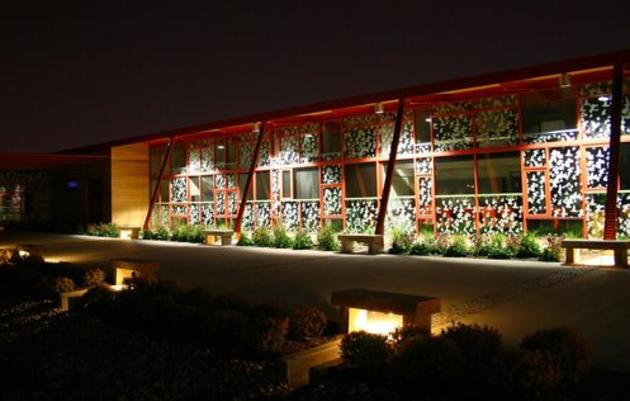
The Grange Insurance Audubon Center in Columbus has its own
new web site. You can view the web site here.
The site contains information about the Center, which just
broke ground on April 22. The site will be updated periodically
to report on Center programs and also to provide news about
construction of the Center building and grounds ahead of their
anticipated opening in May 2009.
Individuals wishing to become founding members of the Center
or to make other donations will be able to do so from the
new web site, using a credit card.
Proposed Constitutional Amendment Appears
to be Final Barrier to Passage of Great Lakes Compact
On April 16 State Sen. Tim Grendell may have finally revealed
the true agenda for his efforts to derail Ohio's ratification
of the Great Lakes Compact. During a hearing of the Ohio Senate
Environment and Natural Resource Committee, Grendell withdrew
all of his remaining objections to the Compact, save one.
He said that we would support ratification without amendment,
provided that the voters of Ohio first pass a constitutional
amendment to exclude groundwater and non-tributary surface
water from the State's public trust obligations.
Over the past two years, Grendell has raised numerous objections
to the Compact, including an argument that his objections
could not be resolved by a constitutional amendment, but rather
only by amendment of the Compact itself. In an abrupt about-face,
however, he now argues that a constitutional amendment would
allay his only remaining concern, namely, alleged ambiguity
in Ohio law as to whether groundwater and non-tributary surface
water is subject to state regulation under the Public Trust
Doctrine.
Grendell has not yet produced a draft of his constitutional
amendment. The public could not vote on such an amendment
until November 2008, and then only if both houses of the General
Assembly vote, by 60 percent supermajorities, to place it
on the ballot, or Grendell and his supporters collect hundreds
of thousands of signatures. Grendell said he would withdraw
his opposition to the Compact if voters approved the as-yet
unwritten constitutional amendment, but he did not say what
he would do if the amendment didn't make it onto the ballot
or was voted down.
Audubon Ohio and other conservation groups immediately characterized
Grendell's latest gambit as yet another effort to throw up
roadblocks to ratification of the Compact, and to enact potentially
harmful constitutional restrictions on the ability of the
State to protect ground and surface water resources. During
testimony before the Committee on April 16, both State Representative
Matthew Dolan (who is sponsoring ratification legislation
that has passed the Ohio House 90-3) and Ohio Department of
Natural Resources Director Sean Logan urged the Committee
to proceed with ratification immediately rather than waiting
for a constitutional amendment that no one has seen, that
may never make it onto the ballot, and that may be voted down
even if it does.
Testimony on the Compact will continue on April 23, when
Audubon Ohio Executive Director Jerry Tinianow is expected
to testify in favor of immediate ratification without amendment.
Kite Festival at VOA - For the Kites and For the Birds
On a weekend in early April, local volunteers with Audubon
Ohio and Audubon Miami Valley presented timely information
at a public event at the Voice of America (VOA) Important
Bird Area about 20 miles north of Cincinnati. Thousands of
visitors attended Kite Fest, a celebration of flying kites
of all sizes, at the VOA in West Chester on April 5 and 6.
Audubon volunteers were there to greet them and provide facts
about some of the specific birds that use the VOA grasslands
and some of the issues surrounding proposed development there.
Butler Metroparks has recently assumed management of most
of the VOA, which has been identified by Audubon as an Important
Bird Area in Ohio because of the population of grassland birds
found there such as Bobolink, Henslow's Sparrow, and Eastern
Meadowlark. Audubon and its friends have been presenting data
and information to Butler Metroparks to help guide some of
the development at the several hundred acre park. We are advocating
for a substantial portion of the grassland habitat to be preserved
so that the unusual grassland birds found there can be maintained.
|